
In short
Svalbard has no indigenous people and no one has ever been born there who was meant to stay. Everyone who came, came for something: whales, furs, coal, the Pole, and now the bears. Four hundred and thirty years of that, in the order the ships meet it.
1596: a Dutchman looking for China
Willem Barentsz sighted the north-west coast on 17 June 1596 while searching for a passage over the top of the world to the East. He named it Spitsbergen, pointed mountains, and sailed on, and died on the way home the following year. Nobody claimed the islands. For the next three centuries they belonged to whoever was there that summer, which is the strangest fact about Svalbard and the one that explains everything after.
The whalers, 1610 to 1700
English and Dutch ships arrived within fifteen years of Barentsz, for the bowhead whale, which was slow, fat and floated when dead. The Dutch built Smeerenburg, Blubber Town, on Amsterdamøya in the 1620s: tryworks, a fort and a summer population in the hundreds. The ruins of the blubber ovens are still there, in the gravel, and ships land beside them. Across the water at Gravneset in Magdalenefjord are the graves of the men who did not go home, more than a hundred of them, under cairns of stone. By 1700 the bowheads of the bays were gone and the whalers followed them out to the ice edge, and then away.


The trappers, 1700 to 1970
Trappers followed the whalers, wintering in log stations for fox, bear, walrus and reindeer through the eighteenth and early nineteenth centuries. Norwegian trappers took over from the 1890s and the last of the professionals were still wintering alone into the 1970s. Their huts are everywhere: a cabin at the head of a fjord, a fox trap of stone and driftwood on a headland, a name carved on a beam. Hilmar Nøis spent 38 winters at Sassen. Wanny Woldstad, the first woman to overwinter as a trapper, did five in Hornsund in the 1930s. The bears they hunted were protected in 1973, and the trapping ended with them.
The Pole, 1897 to 1928
For thirty years the north-west corner of Spitsbergen was the launch pad for the Pole. Salomon Andrée left Danskøya in a hydrogen balloon in July 1897 with two companions and vanished. Their bodies, diaries and undeveloped film were found on Kvitøya in 1930. Walter Wellman tried three times with an airship from Virgohamna, and the rusting remains of his hangar are a landing today. Amundsen flew over the Pole in the airship Norge from Ny-Ålesund in May 1926, with Nobile and Ellsworth. Nobile came back in 1928 in the Italia, crashed on the ice on the way home, and Amundsen died in the search for him. The mooring mast at Ny-Ålesund still stands.
Coal, and the Treaty of 1920
An American, John Munro Longyear, opened the first commercial mine in 1906 and the town that grew around it took his name. Store Norske, the Norwegian company, bought him out in 1916. The question of who owned the islands could not be put off any longer, and on 9 February 1920 the Svalbard Treaty was signed in Paris: sovereignty to Norway, equal rights to live and work for citizens of every signatory, no military use, and taxes that may be spent only on Svalbard. More than forty nations have signed. It is why anyone with a passport from Australia may move to Longyearbyen tomorrow without a visa.


The war
In 1941 the Allies evacuated the mining towns and burned the coal stocks. Germany set up weather stations across the archipelago, because the Arctic weather decides the weather in Europe. In September 1943 the battleship Tirpitz, with Scharnhorst, sailed into Isfjorden and shelled the towns flat, the only time Tirpitz fired her main guns in anger. The last German unit of the war, the weather station Haudegen on Nordaustlandet, surrendered to a Norwegian sealing ship in September 1945, four months after the war ended in Europe, because nobody had come to tell them.
Now
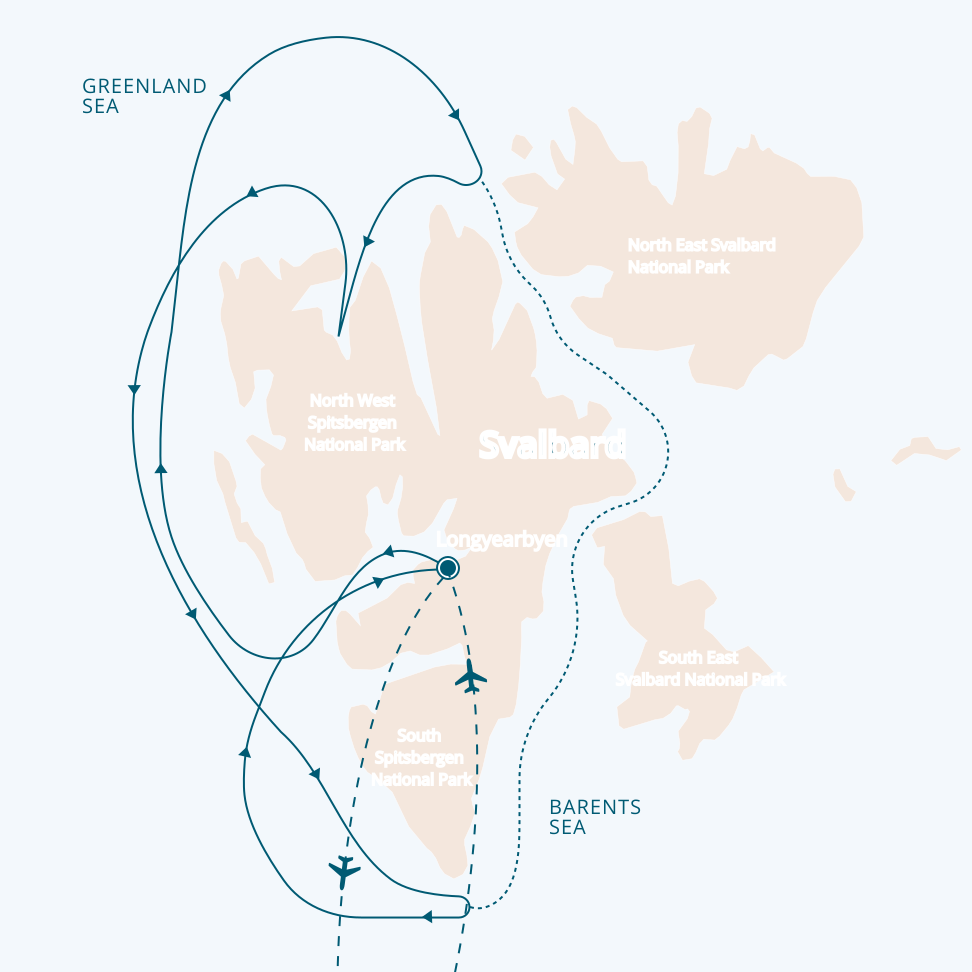
Longyearbyen is a town of about 2,500 people from more than fifty countries, with a university centre, a cemetery that has not taken a burial since 1950, and the Global Seed Vault in the mountain above the airport, opened in 2008 with the world’s crops in cold storage. Ny-Ålesund is a research town of a few dozen scientists in winter and more in summer. Two thirds of the land and nearly all of the sea are protected, and since 2025 the rules for ships are the strictest in the Arctic. Our guide to the 2025 rules explains them, and the Svalbard destination page shows where the voyages go.
What you see from the ship
- Smeerenburg: the blubber ovens of the Dutch whalers in the gravel of Amsterdamøya, and the walrus that now haul out beside them.
- Gravneset, Magdalenefjord: the whalers’ graves under their cairns, with a bear guard on the ridge above.
- Virgohamna: the hangar of Wellman’s airship and the site of Andrée’s balloon shed, in a bay the ships anchor in.
- Ny-Ålesund: Amundsen’s mooring mast, the northernmost post office and a research town that asks you to switch your phone to flight mode.
- Trappers’ huts and fox traps on almost every landing, and the hunting stations of the east coast.
- Longyearbyen itself, a town of fifty nationalities: the Treaty made visible.

Questions we are asked about Svalbard’s history
Do the voyages visit the historic sites?
Most Svalbard voyages land at two or three of them. Smeerenburg, Gravneset and Ny-Ålesund are the most common, and the trappers’ huts appear at random on almost any landing. The 2025 rules limit landings in the protected areas to listed sites, and most of the historic ones are on the list.
Is Svalbard part of Norway?
Yes, under the Treaty, with its own rules: no visa, no VAT, no military and a Governor rather than a council. Flights arrive from Oslo and Tromsø, and Norwegian law applies with the Treaty’s exceptions.


